
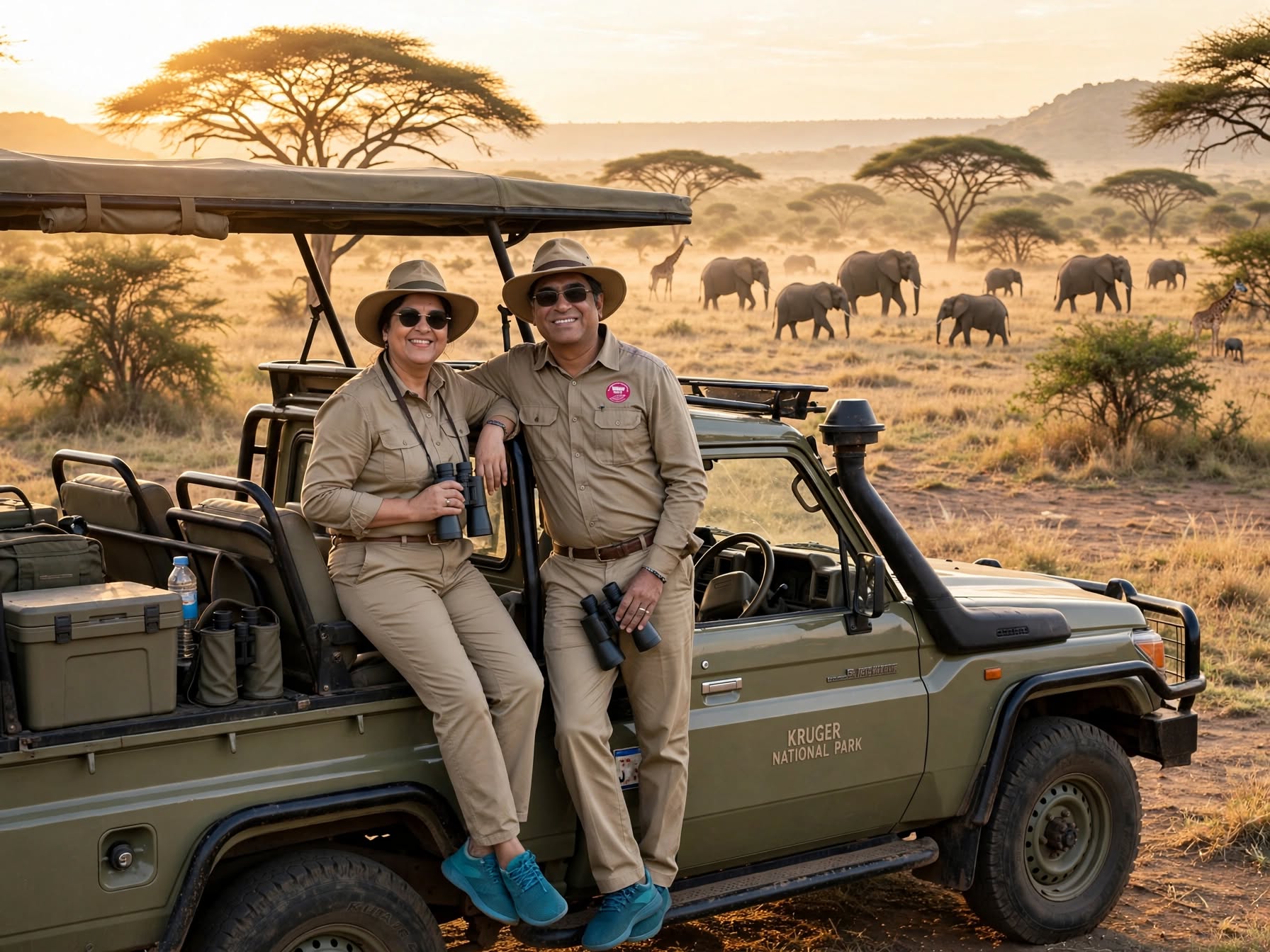
What is Kruger National Park and Why Must You Visit?
Kruger National Park is South Africa’s first national park (est. 1926) and Africa’s most famous safari reserve – 19,480 sq km, bigger than Slovenia. Unlike private reserves, Kruger allows self-drive on 3,000km of roads (850km tarred), making it the most affordable Big 5 safari in Africa.
- 147 mammals, 17,000 elephants, 2,000 lions, 1,000 leopards, 40,000 buffalo, 500 bird species
- Only place where you can see Big 5 in one day on your own car without $500 lodge
- Perfect for Indian travellers – malaria low in winter, vegetarian food at rest camps
- Entry only R602 for international tourists vs $300 in private reserves
Kruger National Park Map – Where Animals Are Found

What Wildlife Can You See in Kruger National Park?
In one day in southern Kruger you can realistically see 20-30 species. Below animals are listed as per tourist craze – most wanted at top. Click any animal name to expand full details – size, weight, lifespan, food, reproduction, behaviour, where to spot, photography.
15 Animals You Will See in Kruger – Ranked by Tourist Craze (Click to Expand)
1. Lion – King of Kruger (Most Wanted)

Scientific: Panthera leo | Population: ~2000 in Kruger | IUCN: Vulnerable | Danger: Very High
Size & Weight: Male 170-250kg, 1.2m shoulder, 2.5-3.3m length. Female 120-180kg. Largest carnivore after elephant.
Lifespan: 10-14 years wild, 20 captivity. Females live longer.
Habitat: Open savanna, grassland with water. Southern Kruger Sabie River highest density. Territory 20-400 sq km.
Food: Carnivore – 5-7kg meat/day. Main prey buffalo (60% diet), zebra, wildebeest, impala. Females hunt 90%. Can eat 30kg in one sitting.
Social Life: Only social big cat. Pride 2-3 males + 5-15 females + cubs. Females stay birth pride, males expelled at 2-3 years form coalition. Roar heard 8km. Sleeps 18-20 hrs/day.
Reproduction: Gestation 110 days, 2-4 cubs 1kg blind. Cubs hidden 6 weeks. 50% mortality. Female first breed 4 years.
Behaviour: Lazy but lethal. Males fight to death for pride. Mother protective. Mock charge vs real charge silent.
Best Time & Location: 05:30-09:00 and 16:00-18:00. H1-2 Skukuza to Lower Sabie, H4-1, S100. Look for vultures, stopped cars.
Photography: 200-400mm, 1/1000s, eye-level, bean bag, no flash. Wait for yawn, cubs playing.
2. Leopard – the Ghost of Kruger

Scientific: Panthera pardus | Population: ~1000 | IUCN: Vulnerable | Danger: Very High
Size & Weight: Male 60-90kg, female 30-60kg, 60-70cm shoulder. Can drag 100kg prey up tree.
Lifespan: 12-15 years wild.
Habitat: Riverine forest, rocky hills, dense bush along Sabie River. Southern Kruger best.
Food: Impala 70% diet, monkeys, birds. 3-5kg/day. Stores kill in tree.
Social: Solitary, territorial 30-80 sq km. Nocturnal but seen daytime on branch. Shy.
Reproduction: Gestation 96 days, 2-3 cubs, stay with mother 18-24 months.
Behaviour: Elusive ghost. If impala stares fixed and snorts, leopard nearby.
Best Location: Dawn/dusk S100 (world famous leopard road), S41, H4-1. Check big trees.
Photography: 300-500mm, spot metering, silent shutter.
3. African Elephant – Gentle Giant

Scientific: Loxodonta africana | Population: 17,000+ | IUCN: Endangered | Danger: High
Size & Weight: Male 5,000-6,500kg, 3.3m shoulder. Female 2,800-3,500kg. Trunk 2m, 40,000 muscles. Tusks up to 2.5m, 50kg.
Lifespan: 60-70 years wild.
Habitat: Needs water daily within 10km river/dam. Southern Kruger Sabie River, Olifants.
Food: Herbivore – 150kg vegetation + 200L water daily. Eats grass, bark, roots, marula fruits. 16-18 hrs eating.
Social: Matriarchal herds 10-50 led by oldest female 60+ years. Bulls solitary after 12 years. Infrasound 10km. Mourns dead.
Reproduction: Gestation 22 months longest mammal! Calf 100-120kg. Stays 10 years with mother. Female breed 10-12 years.
Behaviour: Gentle but dangerous mother with calf or musth bull. Mock charge ears flared.
Best Location: All day near water. Sunset Dam Lower Sabie guaranteed 10-30 elephants.
Photography: Wide 70-100mm for scale, 400mm for eye, baby.
4. White Rhinoceros – Critically Endangered

Scientific: Ceratotherium simum | Population: ~2000 | IUCN: Near Threatened (Black Rhino Critically Endangered)
Size: Male 2,300kg, female 1,700kg, 1.8m shoulder, horn up to 1.5m keratin.
Lifespan: 40-50 years.
Habitat: Open grassland Berg-en-Dal, Crocodile Bridge, Pretoriuskop.
Food: Grazer – 50kg grass/day. Wide mouth. Black rhino browser hook lip.
Social: White semi-social female groups 6-14. Poor eyesight, excellent smell.
Reproduction: Gestation 16 months, calf 40-65kg stays 2-3 years.
Behaviour: Docile but can charge 50km/h. Don’t share live location due to poaching.
Best Location: Early morning 06:00-08:30 open grasslands Berg-en-Dal.
5. African Buffalo – the Black Death

Scientific: Syncerus caffer | Population: 40,000+ | Danger: Very High
Size: Male 700-900kg, female 500-600kg, horns span 1m boss helmet.
Lifespan: 15-25 years.
Habitat: Needs water daily, herds 20-1000. Lower Sabie, Satara, dams.
Food: Grazer 30kg/day grass, drinks 35L, wallows in mud.
Social: Herds led by old female, old bulls bachelor dagga boys in mud.
Reproduction: Gestation 11.5 months, calf 40kg.
Behaviour: Unpredictable, especially solitary old male. Herd defends circle calves inside.
Best Location: Midday near water Lower Sabie, Satara.
6. Cheetah – Fastest Land Animal

Scientific: Acinonyx jubatus | Population: ~300 | Fastest 0-100km/h in 3 sec, 110km/h max | Danger: Low
Size: Male 40-65kg, 80cm shoulder, tail 60-80cm balance, heart 2x lion.
Lifespan: 8-12 years wild high cub mortality 90% killed by lions.
Habitat: Open plains Satara, H1-4, H7, H10 near Lower Sabie.
Food: Hunts by day, impala, steenbok. 2-3kg/day, must eat quickly before lions steal.
Social: Males coalition 2-3 brothers lifelong, females solitary with cubs. Uses termite mounds lookout.
Reproduction: Gestation 90-95 days, 3-5 cubs with mantle grey like honey badger for protection.
Best Location: Early morning 06:00-09:00 Satara S100, S90, H1-4. Look for head on termite mound.
7. African Wild Dog – Painted Wolf (Endangered)

Scientific: Lycaon pictus | Population: ~400 | Most Endangered Carnivore in SA
Size: 20-30kg, 60-75cm shoulder, unique patch pattern like fingerprint.
Lifespan: 10-12 years.
Habitat: Woodland savanna, large territory 400-1000 sq km, dens in aardvark holes.
Food: Most efficient hunter 80% success vs lion 30%. Chase impala 60km/h 2-3km, eats 3-4kg/day.
Social: Packs 10-15 led by alpha pair only alpha breeds. Whole pack cares for pups, babysitters stay at den.
Reproduction: Gestation 70 days, litter 8-12 pups largest carnivore litter. Born in den May-July.
Best Location: Early morning Skukuza-Lower Sabie, Crocodile Bridge. Ask gate rangers.
8. Giraffe – Tallest Animal

Scientific: Giraffa camelopardalis | Population: ~8000 | Height: 5.5m tallest land animal
Size: Male 5.5m 1200kg, female 4.3m 800kg, neck 2.4m but only 7 vertebrae same as humans, tongue 50cm blue-black, heart 11kg.
Lifespan: 20-25 years.
Habitat: Open woodland acacia. Everywhere H11, H4-1.
Food: Browser 34kg leaves/day acacia, drinks every 2-3 days must spread legs vulnerable to crocodiles.
Social: Loose herds 5-20 fission-fusion change daily. Males fight necking swing necks.
Reproduction: Gestation 15 months, calf 2m tall at birth falls 2m stands in 30 mins.
Best Location: All day H11 Skukuza, H4-1.
9. Hippopotamus – River Horse (Most Dangerous)

Scientific: Hippopotamus amphibius | Population: ~8000 | Weight: 3000kg | Danger: Very High kills 500 humans/year Africa
Size: Male 1500-3200kg, 1.5m shoulder, mouth opens 150 degrees canines 50cm, skin 5cm thick red sunscreen blood sweat, can’t swim walks on bottom holds breath 5 mins.
Lifespan: 40-50 years.
Habitat: Water rivers dams Southern Kruger Sabie River Sunset Dam guaranteed 20-40 hippos.
Food: Herbivore 40kg grass/night grazes 5-6 hrs night walks 10km from water.
Social: Pods 10-30 led by dominant male territorial 250m river, bulls fight bloody.
Reproduction: Gestation 8 months calf 30kg born in water mother helps surface.
Best Location: Daytime in water Sunset Dam Lower Sabie best spot.
10. Zebra – Striped Beauty

Scientific: Equus quagga | Population: ~30000 | Unique: Each stripe unique like fingerprint
Size: 220-300kg, 1.3m shoulder, white skin black stripes belly white.
Lifespan: 20-25 years.
Habitat: Open grassland Lower Sabie Satara lives with wildebeest symbiotic zebra eats tall grass wildebeest short.
Food: Grazer 10kg/day grass needs water daily.
Social: Harems 1 stallion + 5-6 mares + foals. Foals stand 15 mins.
Reproduction: Gestation 12-13 months single foal 30kg.
Best Location: All day open grasslands Lower Sabie.
11. Wildebeest (Gnu)

Scientific: Connochaetes taurinus | Population: ~15000 | Blue Wildebeest
Size: Male 250kg female 180kg 1.5m shoulder horns both sexes beard mane.
Lifespan: 20 years.
Habitat: Open savanna Satara Crocodile Bridge Lower Sabie moves with rains.
Food: Grazer short grass 80% diet needs water daily follows zebra.
Social: Herds 20-150 bulls territorial rut display. Calves born 3 weeks synchrony Jan-Feb 90% born same 3 weeks to swamp predators calf stands 7 mins runs 30 mins.
Reproduction: Gestation 8.5 months calf 20kg.
Best Location: Open plains Satara S100, Crocodile Bridge area.
12. Spotted Hyena – the Laughing Hunter

Scientific: Crocuta crocuta | Population: ~2000 | Strongest jaw 800kg bite
Size: Female larger than male female 60-70kg male 50-60kg 80cm shoulder front legs longer sloping back spotted coat.
Lifespan: 12-25 years females dominant matriarchal.
Habitat: All habitats dens in aardvark holes near roads Southern Kruger Skukuza Satara near camps at night.
Food: Not just scavenger 70% kills own prey wildebeest zebra impala eats 14kg one sitting can digest bones horns hooves stomach acid strong laugh call when excited.
Social: Clans 10-80 led by alpha female female has pseudo-penis difficult birth high mortality cubs black.
Reproduction: Gestation 110 days 2 cubs cubs stay den 12 months siblicide stronger kills weaker.
Best Location: Early morning 06:00-07:00 returning to den evening 18:00-19:00 dens near S1 H11 Skukuza.
13. Greater Kudu – Grey Ghost

Scientific: Tragelaphus strepsiceros | Population: ~5000 | Most Beautiful Antelope
Size: Male 250-320kg female 200kg 1.5m shoulder spiral horns 1.2m 2.5 twists female no horns grey white stripes 6-10.
Lifespan: 15-20 years.
Habitat: Dense bush thicket rocky hills Berg-en-Dal Punda Maria shy hides grey ghost blends.
Food: Browser leaves shoots fruits acacia mopane needs water drinks daily can live without water long via succulents.
Social: Females + calves small groups 3-10 males solitary bachelor bulls join females only rut.
Reproduction: Gestation 9 months single calf 15kg hidden 2 weeks mother returns nurse.
Behaviour: Elegant shy jumps 2.5m high when alarmed barks loud can clear 3m fence.
14. Impala – Most Common Antelope

Scientific: Aepyceros melampus | Population: 100,000+ | Most Common Antelope
Size: Male 60kg female 40kg 90cm shoulder lyre-shaped horns male only 75cm reddish coat black M on butt.
Lifespan: 12-15 years.
Habitat: Everywhere light woodland savanna most numerous you will see 1000+ day trip Southern Kruger.
Food: Mixed feeder grazer wet season browser dry season adaptable grass leaves fruits shoots needs water daily.
Social: Harems 1 male + 20 females breeding season bachelor herds outside males territorial roar snort grunt herd jumps 3m high 9m long pronking confuses predators alarm snort.
Reproduction: Rut April-June gestation 6.5 months single lamb Nov-Dec synchronized calving to swamp predators lambs hidden 2 weeks 50% killed first week.
Behaviour: Food for all predators lion leopard cheetah wild dog hyena python very alert grooming favorite prey leopard 70% diet.
15. Warthog – Pumbaa

Scientific: Phacochoerus africanus | Common
Size: Male 75-100kg female 50-75kg 70cm shoulder warts on face protection tusks upper 30-60cm lower sharp fighting tail tuft holds up when running.
Lifespan: 12-15 years.
Habitat: Open savanna grassland near water Southern Kruger Skukuza camp lawns mow grass Lower Sabie Satara burrows in aardvark holes.
Food: Omnivore grass roots bulbs fruits eggs small animals kneels on front knees to eat short grass unique eats 3kg/day.
Social: Females + piglets groups 3-10 sounder males solitary piglets stay 1 year uses burrow backs in tusks face out defence.
Reproduction: Gestation 5.5 months litter 2-4 piglets 500g born in burrow stay 1 week mother protective charges weaning 4 months.
Behaviour: Funny runs tail up antenna kneels to eat can survive without water long mutualism with mongoose mongoose eats ticks off warthog Pumbaa Lion King.
Best Location: Daytime 08:00-16:00 Skukuza camp Lower Sabie roadside.
How to Go to Kruger – Best Way from Johannesburg
Is It Good to Do Day Trip from Johannesburg or Better to Stay Nearby?
- Johannesburg → Paul Kruger Gate: 4.5-5.5h, 400km via N4. Start 04:00, reach 09:30.
- Flight → Skukuza: 1h, R2500-4000 one way.
- Hazyview → Gate: 10 mins – Ideal base.
- Nelspruit → Numbi Gate: 1h, 65km.
Option A: Self-Drive Day Trip (Individually)
Best Route Inside: Paul Kruger Gate → H11 (9km) to Skukuza → H4-1 (50km) along Sabie River to Lower Sabie → Sunset Dam → H10 back → Exit by 17:30. 110km circuit, 6-7 hrs.
Entry: International Adult R602 till Oct 2026, R692 from Nov 2026 + vehicle R44 + admin R59. Book at sanparks.org – gate quotas mandatory.
Option B: Day Tour Package from Johannesburg
Where to Book: GetYourGuide, Viator, MoAfrika Tours, Wild Wings Safaris.
Cost: $337-406 per person (R5500-7500), private $970 pp. Includes pickup/drop Sandton/Rosebank/Pretoria at 06:00, open safari vehicle, ranger, park fees, breakfast pack.
Useful Links for Kruger National Park Tour
- SANParks Official Kruger Park – Book Entry
- Kruger Conservation Fees 2026 – Official Tariff
- GetYourGuide – Kruger Day Tours
All GlimpseTrip Posts on South Africa
- South Africa Travel Guide – Overview
- South Africa Visa for Indians 2026
- Cape Town Travel Guide
- Johannesburg Travel Guide
- Hazyview – Best Base for Kruger
🌍 Loved this Travel Guide? Join GlimpseTrip Family!
We are creating worldwide travel guides – 70+ cities live! Get new guides, hidden gems, maps & itineraries in your inbox – No spam, only travel love.
💬 Have a question? Want custom itinerary? Your feedback means world to us!
Write to us: contact@glimpsetrip.com – We reply within 24 hours!
Or use our Contact Page – Share appreciation, questions, suggestions & valuable feedback.
🙏 Your small feedback helps us make better guides for all travellers – Thank you for being part of GlimpseTrip journey!
Safe travels from GlimpseTrip – See the world, with a glimpse of wonder!
Leave a Reply