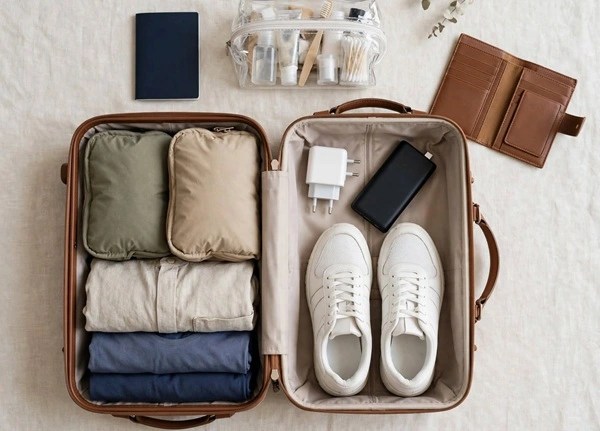
Planning your first international trip can be exciting—but packing for it can also feel confusing.
What should go in your suitcase? What should stay in your carry-on? How many clothes do you really need? Should medicines go in checked baggage? What about chargers, power banks, toiletries, important documents and travel adapters?
The good news is that you don’t need to pack your entire home.
A well-planned international travel packing list is about carrying the right things, in the right place, in the right quantity.
This complete GlimpseTrip packing guide is designed especially for first-time international travellers. It covers everything from passports and travel documents to clothing, toiletries, medicines, electronics, money, emergency items and airport-security essentials.
GlimpseTrip Recommendation: Before packing, always check your airline’s baggage allowance, cabin-bag dimensions, weight limits and prohibited-items list. These rules can vary between airlines and airports.
1. Start With Your Destination
Don’t start packing by opening your wardrobe.
Start by researching your destination.
Your packing requirements can change dramatically depending on:
- Country and city
- Season
- Weather
- Temperature
- Rainfall
- Humidity
- Cultural customs
- Planned activities
- Hotel facilities
- Length of the trip
- Type of transportation
- Whether you are visiting one country or several
For example, a winter trip to Europe requires very different clothing from a tropical holiday in Southeast Asia.
Before packing, check:
- Expected daytime temperature
- Night-time temperature
- Rain forecast
- Local weather conditions
- Dress customs
- Religious-site dress requirements
- Planned activities
- Hotel facilities
- Laundry availability
- Local transportation
- Special equipment requirements
A simple rule
Pack for the trip you are actually taking—not the trip you imagine you might take.
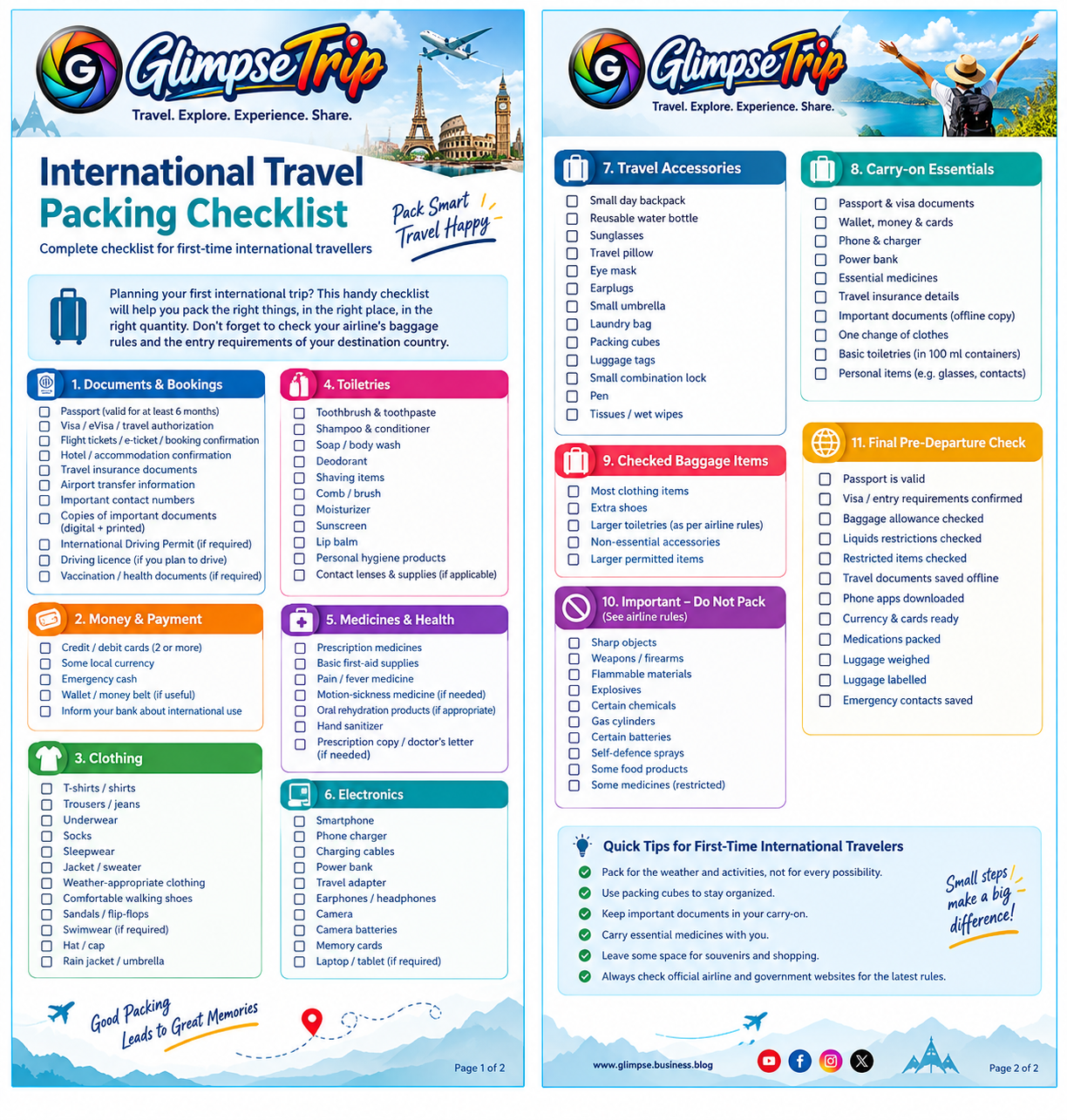
2. Your International Travel Packing Checklist at a Glance
Before going into detail, here is your master checklist.
Essential Documents
- Passport
- Visa or electronic travel authorization, if required
- Flight tickets or booking confirmation
- Hotel/accommodation confirmation
- Travel insurance documents
- Airport transfer information
- Important contact numbers
- Copies of important documents
- International Driving Permit, if required
- Driving licence, if you plan to drive
- Required vaccination or health documents, where applicable
Money & Payment
- Credit/debit cards
- Some local currency
- Emergency cash
- Wallet
- Money belt or secure pouch, if useful
Clothing
- T-shirts/shirts
- Trousers/jeans
- Underwear
- Socks
- Sleepwear
- Jacket or sweater
- Weather-appropriate clothing
- Comfortable walking shoes
- Sandals/flip-flops
- Swimwear, if required
- Hat/cap
- Rain jacket or umbrella
Toiletries
- Toothbrush
- Toothpaste
- Shampoo
- Soap/body wash
- Deodorant
- Shaving items
- Comb/brush
- Moisturizer
- Sunscreen
- Lip balm
- Personal hygiene products
- Contact lenses and supplies, if applicable
Medicines & Health
- Regular prescription medicines
- Basic first-aid supplies
- Pain/fever medicine
- Any personally required medicines
- Prescription copies or doctor’s documentation where appropriate
- Motion-sickness medicine if needed
- Oral rehydration products if appropriate
- Hand sanitizer
Electronics
- Smartphone
- Phone charger
- Charging cables
- Power bank
- Travel adapter
- Earphones/headphones
- Camera
- Camera batteries
- Memory cards
- Laptop/tablet if required
Useful Travel Items
- Small day backpack
- Reusable water bottle
- Sunglasses
- Travel pillow
- Eye mask
- Earplugs
- Small umbrella
- Laundry bag
- Packing cubes
- Luggage tags
- Small combination lock
3. Passport: The Most Important Item
Your passport is the most important physical document for most international trips.
Before travelling, check:
- Passport validity
- Blank pages if required
- Name and date of birth
- Passport number
- Expiry date
- Damage to the passport
- Visa requirements for your destination
Some countries require your passport to remain valid for a certain period beyond your planned stay. Requirements vary by destination, so check the official immigration or government website of the country you are visiting.
Make backup copies
Keep copies of your passport:
- On your phone
- In secure cloud storage
- In your email account
- In a separate physical location from the original
However, never treat a photocopy or digital copy as a replacement for your original passport.
Important
Do not put your only passport in checked baggage.
Keep your passport in your personal item or carry-on bag where you can access it easily.
4. Visa and Entry Documents
Depending on your nationality and destination, you may need:
- Traditional visa
- eVisa
- Electronic travel authorization
- Visa on arrival
- Transit visa
- Proof of onward/return travel
- Hotel reservation
- Proof of funds
- Travel insurance
- Other entry documents
Always check the requirements for your nationality, not just the country you are travelling from.
Save:
- Visa approval
- Application reference
- Electronic authorization
- Hotel booking
- Flight booking
- Travel insurance
- Important correspondence
Keep important documents available offline on your phone in case you do not have internet access.
5. Flight Tickets and Travel Itinerary
Keep your flight information easily accessible.
Save:
- Departure airport
- Arrival airport
- Flight number
- Departure time
- Arrival time
- Terminal information
- Booking reference
- Connecting-flight information
For multi-city trips, create a simple itinerary containing:
Date → City → Hotel → Flight/Train → Major activity
This can save considerable time when you are tired or confused after a long journey.
6. Travel Insurance Documents
Travel insurance can be particularly important for international travel.
Keep a digital and, preferably, printed copy of your policy information.
Check whether your policy covers the activities you plan to undertake and the countries you will visit.
The policy may include different levels of cover for things such as:
- Medical treatment
- Emergency evacuation
- Trip cancellation
- Trip interruption
- Lost baggage
- Delayed baggage
- Travel delays
- Personal liability
Do not simply buy the cheapest policy without reading the coverage.
7. Money, Cards and Currency
You generally do not need to carry a large amount of cash.
A practical combination is:
- One or two payment cards
- Some local currency
- Emergency cash
- A secure wallet
Carry backup payment options
Do not keep all your cards and cash in one place.
For example:
Wallet: Primary card + limited cash
Secure backup: Second card + emergency cash
This can be extremely useful if your wallet is lost or stolen.
Before leaving home
Inform your bank if required about international transactions and check:
- Foreign transaction fees
- ATM withdrawal charges
- Currency conversion charges
- Daily withdrawal limits
- Card usage abroad
8. Clothing: Pack for the Weather, Not for Every Possibility
One of the most common mistakes first-time travellers make is packing too many clothes.
Instead of packing a separate outfit for every day, choose clothes that can be combined.
Basic clothing checklist
- T-shirts/shirts
- Trousers
- Jeans
- Shorts, where appropriate
- Underwear
- Socks
- Sleepwear
- Lightweight jacket
- Sweater/fleece
- Rainwear
- Comfortable walking shoes
- Sandals
- Hat/cap
For cold destinations
Consider:
- Thermal base layers
- Warm jacket
- Sweater/fleece
- Gloves
- Scarf
- Warm socks
- Thermal socks
- Winter hat
- Waterproof footwear
For hot destinations
Consider:
- Lightweight clothing
- Breathable fabrics
- Comfortable walking shoes
- Sandals
- Hat
- Sunglasses
- Sunscreen
- Lightweight rain protection
9. How Many Clothes Should You Pack?
There is no universal number because the answer depends on the destination, trip length and laundry facilities.
For a typical 7–10 day trip, you could start with something like:
- 5–7 tops
- 2–3 trousers/jeans
- 7–10 underwear
- 5–8 pairs of socks
- 1 sleepwear set
- 1 light jacket or sweater
- 1 pair of comfortable walking shoes
- 1 additional footwear option
Adjust this according to:
- Weather
- Activities
- Dress requirements
- Laundry availability
- Personal preference
The 80% rule
Before putting something in your suitcase, ask:
“Will I realistically use this?”
If the answer is probably no, leave it at home.
10. Comfortable Shoes Are More Important Than Extra Clothes
Travellers often underestimate how much walking they will do.
A sightseeing day can easily involve several hours on your feet.
Prioritize:
- Comfort
- Proper fit
- Good grip
- Weather suitability
- Already-broken-in footwear
Avoid taking brand-new shoes
A new pair may look great but cause:
- Blisters
- Foot pain
- Discomfort
- Reduced enjoyment
Your best travel shoes are usually the ones you already know are comfortable.
11. Toiletries Packing Checklist
You do not need to take your entire bathroom.
Basic toiletries
- Toothbrush
- Toothpaste
- Face wash
- Soap/body wash
- Shampoo
- Conditioner, if needed
- Deodorant
- Shaving items
- Comb/brush
- Moisturizer
- Sunscreen
- Lip balm
- Personal hygiene products
Travel-size containers
Where practical, use smaller containers rather than carrying full-size bottles.
Remember that liquids, gels, creams, pastes and aerosols can be subject to airport-security restrictions when carried in cabin baggage. Rules vary by airport, so check the security requirements of your departure and transit airports before flying.
At many airports, cabin liquids are restricted to containers of no more than 100 ml, but some airports have different procedures or newer screening arrangements. Therefore, do not assume that the rules at one airport apply everywhere.
12. Your Carry-On Liquids Bag
If your departure airport requires liquids to be presented in a transparent bag, prepare it before reaching security.
Typical items that may be treated as liquids, gels or similar substances include:
- Toothpaste
- Shampoo
- Conditioner
- Perfume
- Lotion
- Cream
- Gel
- Liquid makeup
- Mascara
- Deodorant spray
- Hand sanitizer
- Contact-lens solution
Some airports require these to be placed in a transparent resealable bag.
GlimpseTrip Tip
Keep your liquids bag near the top of your carry-on.
That way, you can remove it quickly if airport security asks you to do so.
13. Medicines: Always Keep Essential Medicines Accessible
If you take regular medication, plan this before packing.
Keep essential medicines in your carry-on rather than relying entirely on checked baggage, because checked bags can be delayed or lost. Official travel guidance also recommends keeping necessary medication with you.
Consider carrying
- Regular prescription medicines
- Prescription copies
- Doctor’s letter where appropriate
- Basic first-aid items
- Any medicines you may need during the journey
Important for international travel
Medication that is legal in one country may be restricted in another.
For medicines containing controlled substances, some countries have specific documentation or quantity requirements.
Before travelling, check the rules of your destination country and any transit countries.
14. Basic Travel First-Aid Kit
A small travel health kit can be useful.
Depending on your personal needs, it may include:
- Adhesive bandages
- Small antiseptic supplies
- Basic pain/fever medicine
- Oral rehydration products
- Motion-sickness medicine
- Any personally required over-the-counter medicine
- Personal prescription medication
Do not carry medicines simply because someone else recommended them.
If you have a medical condition or regularly use prescription medicines, speak with your doctor or pharmacist before travelling.
15. Electronics Packing Checklist
Modern travel involves a surprising amount of electronics.
Essential
- Smartphone
- Phone charger
- Charging cable
- Power bank
- Travel adapter
Optional
- Laptop
- Tablet
- Camera
- Camera charger
- Spare batteries
- Memory cards
- Headphones
- Smartwatch charger
- Portable storage device
Keep electronics protected
Use:
- Small electronics pouch
- Cable organizer
- Protective cases
- Separate camera bag, if necessary
Avoid putting fragile electronics loosely into your suitcase.
16. Travel Adapter: One of the Most Commonly Forgotten Items
Electrical sockets vary around the world.
Before travelling, check:
- Plug type
- Voltage
- Frequency
A universal travel adapter can be particularly useful if you visit multiple countries.
Important distinction
A plug adapter changes the physical shape of the plug.
A voltage converter/transformer is different.
Many modern phone and laptop chargers support a range of input voltages, but you should check the label on your particular device or charger before connecting it to a different electrical system.
17. Power Bank: Keep It Accessible
A power bank can be extremely useful when travelling.
It can help you keep your:
- Phone
- Navigation
- Boarding pass
- Translation apps
- Emergency contacts
available during long journeys.
However, battery and power-bank carriage rules can vary by airline and jurisdiction. Check your airline’s current requirements before flying.
As a general packing principle, items that are restricted from checked baggage should not simply be placed in your suitcase without checking the applicable rules.
18. Smartphone: Your Digital Travel Companion
Your phone can replace many separate travel items.
Before leaving home, make sure you have:
- Airline app
- Hotel booking
- Maps
- Translation app
- Currency converter
- Travel insurance details
- Emergency contacts
- Important documents stored offline
- Accommodation address
- Transport information
Download important information offline
Do not assume you will always have:
- Mobile data
- Wi-Fi
- Battery
- Network coverage
Save important information offline whenever possible.
19. SIM Card and eSIM Preparation
Before travelling internationally, decide how you will stay connected.
Options may include:
- International roaming
- Local SIM
- Travel SIM
- eSIM
- Wi-Fi
Check whether your phone is:
- Unlocked
- eSIM compatible
- Compatible with the destination network
If using an eSIM, consider installing it before departure if the provider allows it.
20. Travel Documents: Keep a Digital Backup
Create a folder on your phone containing:
- Passport copy
- Visa
- Flight bookings
- Hotel bookings
- Travel insurance
- Emergency contacts
- Important reservations
- Driving documents
- Other required travel documents
You can also store copies in secure cloud storage.
But remember
Digital copies are backups—not necessarily legally valid substitutes for original documents.
21. Small Travel Items That Make a Big Difference
Some inexpensive items can make international travel much easier.
Consider:
- Packing cubes
- Laundry bag
- Foldable shopping bag
- Small backpack
- Reusable water bottle
- Sunglasses
- Travel pillow
- Eye mask
- Earplugs
- Small umbrella
- Luggage tags
- Small combination lock
- Pen
- Tissues
- Wet wipes
Never underestimate a pen
A simple pen can be useful for:
- Immigration forms
- Customs forms
- Notes
- Travel information
It takes almost no space, so keep one in your carry-on.
22. What Should Go in Your Carry-On?
Your carry-on should contain the things you cannot afford to lose or be separated from during the journey.
Carry-on essentials
- Passport
- Visa/entry documents
- Wallet
- Money
- Credit/debit cards
- Phone
- Charger
- Power bank
- Essential medicines
- Travel insurance information
- Important documents
- Valuable electronics
- One change of clothes
- Basic toiletries
- Essential personal items
Why carry a change of clothes?
If your checked baggage is delayed, having:
- underwear
- socks
- T-shirt/shirt
can make the first day much easier.
23. What Should Go in Checked Baggage?
Checked baggage is generally suitable for items that:
- Are not needed during the flight
- Are too large for cabin baggage
- Are permitted in checked baggage
- Are not valuable or irreplaceable
Examples:
- Most clothing
- Extra shoes
- Larger toiletries where permitted
- Non-essential accessories
- Larger permitted items
However, always check your airline’s prohibited and restricted-item rules before packing.
24. Never Put These Important Items Only in Checked Baggage
Avoid putting your only:
- Passport
- Visa documents
- Wallet
- Bank cards
- Essential medication
- Phone
- Laptop
- Camera
- Important travel documents
- Irreplaceable valuables
in checked baggage.
If your suitcase is delayed, you may not have access to these items.
25. Checked Baggage Packing Strategy
Pack your suitcase in layers.
Bottom layer
- Shoes
- Heavier items
Middle layer
- Folded or rolled clothing
- Packing cubes
Upper layer
- Lighter clothing
- Items you may need first
You can also use packing cubes to separate:
- Shirts
- Trousers
- Underwear
- Electronics
- Accessories
This makes it much easier to find things without emptying your entire suitcase.
26. Keep Some Space in Your Suitcase
Do not fill your suitcase to 100% capacity before leaving home.
Leave some space for:
- Souvenirs
- Gifts
- Shopping
- Clothing purchases
Also keep the weight comfortably below your airline’s maximum allowance rather than trying to use every gram available.
27. Weigh Your Luggage Before Leaving Home
This simple step can prevent an unpleasant surprise at the airport.
Use a luggage scale if available.
Check both:
- Checked-baggage weight
- Carry-on weight
Remember that airlines can have different limits for different fares and routes.
Your airline’s official baggage policy should always be the final reference.
28. Luggage Identification
Make your suitcase easy to identify.
Add:
- Luggage tag
- Distinctive strap
- Colourful ribbon
- Unique sticker
Record your luggage details, including:
- Brand
- Colour
- Size
- Identifying marks
Taking a photo of your suitcase before checking it in can also be useful.
29. Protect Your Luggage
You can use:
- A suitable luggage lock
- Luggage strap
- Protective cover
- Durable luggage tag
If using a lock for air travel, check whether your airline or airport has any specific requirements.
Never rely on a lock as your only security measure.
30. Food and Snacks
A few snacks can be useful during long journeys.
Possible options include:
- Biscuits
- Energy bars
- Dry snacks
- Packaged food
But food import rules can be strict.
A food item that is permitted through airport security may still be restricted when entering another country.
Before carrying fresh food, meat, dairy products, fruits, vegetables, seeds or other agricultural products internationally, check the destination country’s customs and biosecurity rules.
31. Jewellery and Valuables
Avoid travelling with expensive jewellery unless necessary.
If you do need to carry valuable items:
- Keep them in your carry-on
- Avoid displaying them unnecessarily
- Do not put irreplaceable items in checked baggage
- Check whether your travel insurance covers them
32. What NOT to Pack
Never assume that an item is allowed simply because you have carried it before.
Restrictions can apply to:
- Sharp objects
- Weapons
- Flammable materials
- Explosives
- Certain chemicals
- Gas cylinders
- Certain batteries
- Self-defence sprays
- Some food products
- Some medicines
Rules can differ between cabin baggage and checked baggage.
Always check your airline and departure airport’s official prohibited-items guidance before packing.
33. Packing for a Multi-Country Trip
If you are visiting several countries, packing becomes slightly more complicated.
Consider:
- Different weather conditions
- Different electrical plugs
- Different currencies
- Different dress customs
- Different transport systems
- Different baggage rules
- Different visa requirements
Use one master folder
Keep all bookings organized by date:
Day 1–3 → Country A
Day 4–7 → Country B
Day 8–12 → Country C
This makes multi-country travel much easier to manage.
34. Packing for Different Types of Trips
City Holiday
Prioritize:
- Comfortable shoes
- Light clothing
- Small day bag
- Camera/phone
- Weather protection
Beach Holiday
Add:
- Swimwear
- Sunscreen
- Sunglasses
- Hat
- Sandals
- Beach bag
Winter Holiday
Add:
- Thermal layers
- Warm jacket
- Gloves
- Scarf
- Warm socks
- Appropriate footwear
Adventure Trip
Add equipment according to the activity:
- Hiking shoes
- Rain protection
- Headlamp
- Suitable backpack
- Activity-specific equipment
Always check whether specialist equipment can be carried on the aircraft.
35. Packing for Religious and Cultural Sites
Some destinations require visitors to follow particular dress standards at:
- Mosques
- Temples
- Churches
- Monasteries
- Shrines
- Religious ceremonies
Research these requirements before your trip.
A lightweight scarf or suitable extra layer can sometimes be extremely useful.
36. Packing for Rainy Weather
If rain is expected, consider:
- Compact umbrella
- Waterproof jacket
- Quick-drying clothes
- Waterproof footwear
- Waterproof phone pouch
- Small waterproof bag
Protect cameras, documents and electronics from water.
37. Packing for Long-Haul Flights
For long flights, keep these in your personal item:
- Passport
- Phone
- Charger
- Power bank
- Headphones
- Eye mask
- Earplugs
- Travel pillow
- Water bottle, empty before security if required
- Basic toiletries
- Essential medication
- Light jacket
- Change of clothes
Wear comfortable clothing and shoes.
38. The 24-Hour Emergency Bag
One of the best packing strategies is to imagine:
“What if my checked suitcase doesn’t arrive tonight?”
Your carry-on should contain enough essentials to get through at least the initial period comfortably.
Consider carrying:
- One change of clothes
- Underwear
- Socks
- Essential medication
- Toothbrush
- Basic toiletries
- Phone charger
- Important documents
This simple strategy can make a major difference if your checked baggage is delayed.
39. Final Packing Checklist — One Day Before Departure
Documents
☐ Passport
☐ Visa/entry authorization
☐ Flight booking
☐ Hotel booking
☐ Travel insurance
☐ Important contact information
☐ Copies of important documents
Money
☐ Credit/debit cards
☐ Local currency
☐ Emergency cash
Clothing
☐ Tops
☐ Trousers
☐ Underwear
☐ Socks
☐ Sleepwear
☐ Jacket/sweater
☐ Comfortable shoes
☐ Weather-specific clothing
Toiletries
☐ Toothbrush
☐ Toothpaste
☐ Deodorant
☐ Shampoo
☐ Soap
☐ Sunscreen
☐ Personal hygiene items
Health
☐ Prescription medicines
☐ Required medical documents
☐ Basic first-aid supplies
Electronics
☐ Smartphone
☐ Phone charger
☐ Charging cables
☐ Power bank
☐ Travel adapter
☐ Headphones
☐ Camera
☐ Memory cards
Travel Accessories
☐ Luggage tags
☐ Luggage lock
☐ Day bag
☐ Sunglasses
☐ Umbrella
☐ Reusable water bottle
☐ Laundry bag
☐ Pen
40. Final Airport-Security Check
Before leaving for the airport, ask yourself:
Do I have my passport?
Do I have the required visa or entry authorization?
Do I have my wallet and cards?
Do I have my phone?
Do I have my essential medicines?
Do I have my boarding information?
Do I know my baggage allowance?
Have I checked the liquid restrictions?
Have I checked restricted and prohibited items?
Is my luggage within the weight limit?
If the answer to all of these is YES, you are in a much better position to start your journey confidently.
41. The Golden Rule of International Packing
You do not need to pack everything you own.
You need to pack what you will actually use.
A good international traveller’s suitcase should be:
Practical + Organized + Comfortable + Secure + Within the airline’s limits
The most important things are not necessarily the things that take up the most space.
Your passport, documents, money, medicines, phone and essential travel information deserve much more attention than an extra pair of shoes or another outfit.
42. GlimpseTrip’s Simple Packing Formula
If you are overwhelmed by the whole process, remember this:
DOCUMENTS
Passport + Visa + Tickets + Hotel + Insurance
MONEY
Cards + Local Currency + Emergency Cash
CLOTHES
Comfortable + Weather-appropriate + Mix-and-match
HEALTH
Medicines + First Aid + Personal Essentials
TECHNOLOGY
Phone + Charger + Power Bank + Adapter
COMFORT
Shoes + Toiletries + Sleep/Flight Essentials
BACKUP
Digital copies + Emergency contacts + One change of clothes in carry-on
Pack smart. Travel light. Keep essentials close.
Important Reminder
Airline, airport-security, customs, immigration and destination-country rules can change. Always check the official airline, departure airport, transit airport and destination-country government/immigration websites shortly before your journey.
Liquid restrictions, baggage allowances, battery rules, medicines, food and other restricted items may have different requirements depending on where you are travelling from, where you are connecting and where you are going.
For medicines and medical equipment, check the rules of both your airline and destination country. Some medicines may have additional restrictions or documentation requirements.
More GlimpseTrip Travel Tips
Coming soon:
- How to Open a Suitcase Lock When You Forget the Code
- International Travel Documents Checklist
- First-Time International Flyer: Complete Airport Guide
- Passport Travel Tips Every Traveller Should Know
- Visa vs eVisa vs Visa on Arrival
- SIM Card vs eSIM for International Travel
- Travel Insurance: Is It Really Necessary?
- Common Tourist Scams and How to Avoid Them
- What to Do If Your Checked Baggage Is Lost
Travel. Explore. Experience. Share.
GlimpseTrip


Leave a comment